


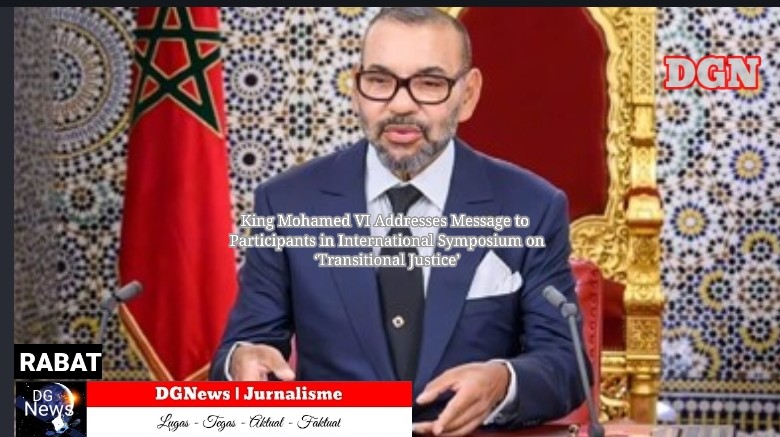

RABAT – His Majesty King Mohammed VI, may God assist Him, addressed a message to the participants in an international symposium on “Transitional Justice,” organized in Rabat in commemoration of the 20th anniversary of the Equity and Reconciliation Commission, under the theme “Transitional justice processes: for sustainable reforms”, Friday, 06-12-2024.
Here follows the full text of the Royal Message, which was read out by the Chairperson of the National Human Rights Council, Amina Bouayach.
“Praise be to God, May peace and blessings be upon the Prophet, His Kith and Kin.
Ladies and Gentlemen, it is a pleasure to send this message to the participants in this international symposium to which I have granted my high patronage. Your meeting, which commemorates the twentieth anniversary of the creation of the Equity and Reconciliation Commission, will address the theme “Transitional Justice Pathways for the Implementation of Sustainable Reforms”.
Your commemoration of this important event in Moroccan contemporary history provides a good opportunity to recall the significance of that milestone. Indeed, the creation of the Committee was a turning point in our country’s development and democratic policy. It constituted a crucial building block in the transition to democracy, in the consolidation of the rule of law and of institutions, and in the protection of freedoms.
Your symposium, which is significant from the historical, social, political and rights perspective, is a chance to commend our country’s achievements in the process of transitional justice – a process based on a wise, far-sighted approach, the main features of which were transparency and objectivity. This is also an opportunity to remind current and future generations of the reforms and reconciliations that have taken place in the Kingdom of Morocco, for which a bold policy based on consensus was adopted when we revisited our history, without any inferiority complex.
Ladies and Gentlemen, my decision to establish the Equity and Reconciliation Commission, which is a continuation of the Independent Commission on Compensation for Victims of Enforced Disappearance and Arbitrary Detention established by my venerable father, His late Majesty King Hassan II – may God bless his soul – was a sovereign decision that was part of a proactive process for managing public affairs. Based on a new concept of authority and on holding public institutions to account, that process aims to make sure all Moroccans enjoy a dignified life.
In addition to achieving national reconciliation and addressing past abuses, the concept used was primarily aimed at making transitional justice a priority in the democratic transition. Both the state and the citizens had, at the time, developed a proactive perception regarding not only the magnitude of the deep changes the world had witnessed in the late 1980s, but also the importance of democratic values and human rights in strategic policies.
Transitional justice in our country was based on rock-solid foundations – both historical ones, relating to the specific features of the Moroccan identity, and regional and geographical ones. The goal was to address the cases of all victims, irrespective of their background or political affiliation. The focus was therefore placed on all human rights violations, from the early years of independence to the creation of the Equity and Reconciliation Commission.
This made it possible to identify and look into all forms and types of abuse our country witnessed in the past, irrespective of their nature or scope. We were also able to conduct the necessary field investigations and inquiries, organize public hearings in cities and villages, and collect testimonies to establish the truth and achieve individual and collective grievance redress, taking into account the gender perspective, thus further enhancing Moroccans’ reconciliation with their history.
Perhaps one of the most distinctive features of the Moroccan experience in this regard was the full engagement of civil society – regardless of affiliation or leanings – in shaping the process and making sure it is a success. The decision to achieve transitional justice had the merit of helping to launch a public debate as well as community-based discussions on various reforms and key issues that were of interest to national public opinion.
Through several successive initiatives, transitional justice contributed to enhancing collective awareness about combating human rights violations. Lessons were drawn from the country’s experience, and the need to continue consolidating the foundations of the rule of law was emphasized so as to make sure rights and freedoms were respected, and strike a balance between exercising those rights and freedoms in a responsible, civic manner, and fulfilling one’s duties and obligations.